Over the past five to ten years, something subtle but important has been happening inside many organizations. Increasingly, business executives are relying less on their internal technical teams to deliver innovative solutions, and instead they are choosing to acquire the technology they need or partner with another organization that already has it. In other words, when a strategic capability is missing, the instinct is no longer “let’s build it,” but rather “who already has it?”
This shift deserves some attention because, historically speaking, technology has been one of the most powerful competitive levers available to an organization. Companies captured markets and leapfrogged competitors precisely because their technical teams could build capabilities that others could not replicate quickly. Those teams created proprietary platforms, unique customer experiences, and operational efficiencies that translated directly into growth.
For decades, technical excellence and business innovation were closely linked. Yet recently the relationship appears to have weakened. Many executives still acknowledge that technology is essential, but when faced with an innovation gap they are increasingly skeptical that their own IT organization will close it in time. Instead of funding internal development, they look outside the organization for solutions that are already packaged, already operating, and already proven.
That change in behavior raises a fair question. What exactly has changed?
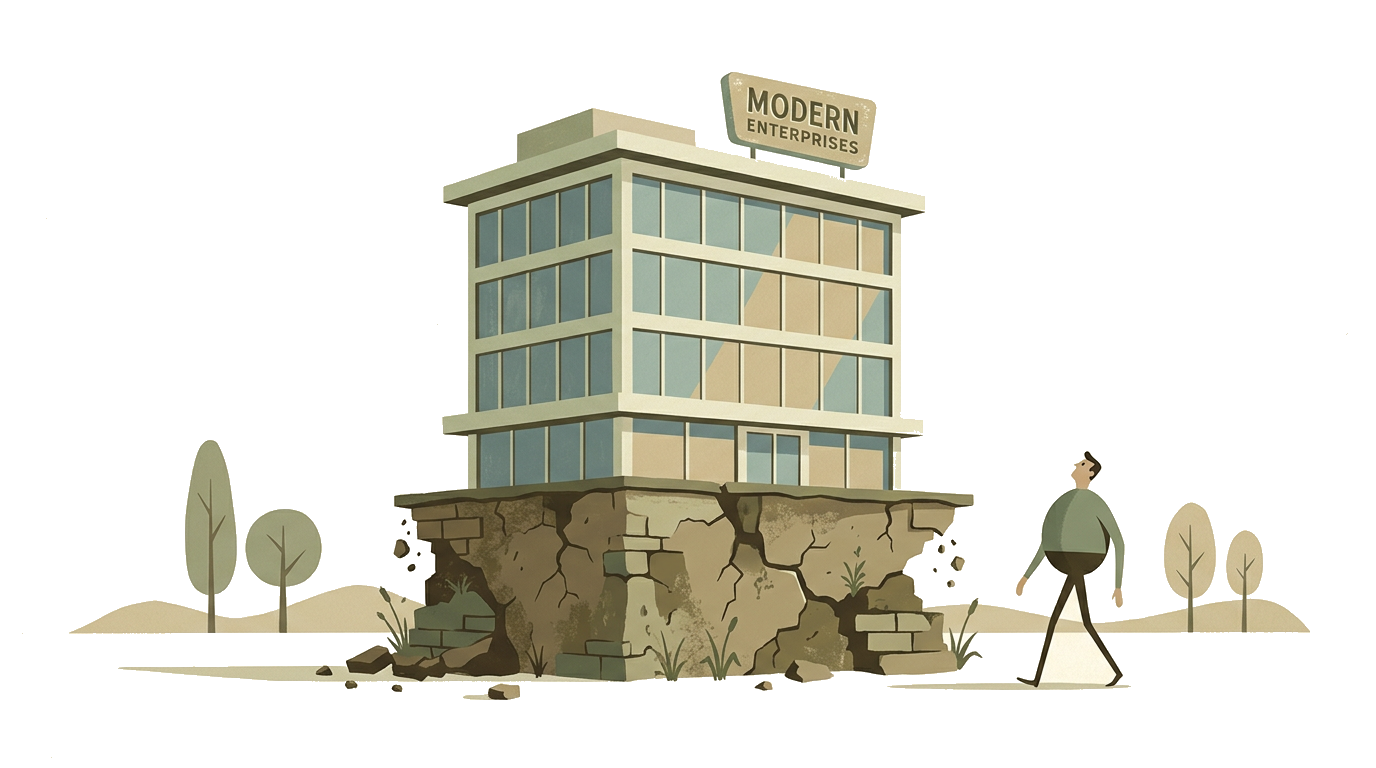
Part of the answer is structural. Over the past twenty years, most large organizations have accumulated significant layers of technical debt across their application portfolios. Systems built in different eras, using different frameworks and architectural patterns, were rarely aligned under a common engineering model or architectural standard. Each system worked, in isolation, but collectively they created a complex operating environment that became increasingly difficult to evolve. Innovation slows down when every new feature requires navigating brittle integrations, inconsistent data models, or aging infrastructure.
Another factor is credibility. In many organizations, business leaders have experienced repeated delays or unpredictable outcomes when relying on internal development initiatives. Projects stretch, priorities shift, and the original intent of the work becomes diluted as teams attempt to reconcile competing architectural constraints. Eventually executives adjust their expectations. If the organization cannot reliably deliver a new capability within a defined timeframe, they begin looking elsewhere.
The recent wave of artificial intelligence projects has amplified this dynamic. AI was introduced to boardrooms as a transformative capability, capable of improving productivity, decision making, and customer engagement. In practice, many early AI initiatives struggled because the underlying data infrastructure and application architecture were not prepared to support them. The technology itself was promising, but the environment in which it needed to operate was fragmented. The result, in many cases, was disappointment.
At that point a deeper issue begins to surface. The challenge is not only technical. It is also communicative. Business executives and technical teams often operate with different mental models and different vocabularies. Executives speak in terms of market opportunity, customer impact, revenue growth, and operational risk. Technical teams speak in terms of architecture, integration patterns, deployment pipelines, and data structures. Both perspectives are valid, yet they do not always translate cleanly across the table.
When that translation fails, trust erodes quietly. The business side may conclude that the technology organization is overly focused on internal complexity rather than business outcomes. The technical side may conclude that leadership underestimates the constraints imposed by the current architecture. Everyone continues working hard, but the shared language that enables confident decision making begins to weaken.
This is where modernization becomes less about technology and more about alignment. It is difficult for a technology organization to be viewed as a source of innovation when its own application portfolio lacks consistency and reliability. When every system behaves differently, every integration requires custom handling, and every deployment path is unique, the organization spends most of its time maintaining the past rather than building the future. Even the most capable engineering teams struggle to innovate under those conditions.
A more productive approach begins by stabilizing the foundation. That means reducing technical debt across the application portfolio while establishing a consistent operating model for how applications are built, integrated, and deployed. When systems share common patterns such as REST and GraphQL APIs, standardized CI/CD deployment packages, and predictable integration models, the environment becomes far easier to evolve. Innovation accelerates because engineers are working from a shared framework rather than reinventing the plumbing each time a new capability is required.
At the same time, modernization creates a shared language between business leaders and technical teams. Once the architecture is consistent and reliable, conversations shift naturally toward outcomes. Roadmaps become easier to define. Dependencies become clearer. Delivery timelines become more predictable. In short, the organization regains confidence that it can translate strategy into working software.
That confidence matters more than many people realize. When executives believe their internal teams can deliver, they invest in them. When they do not, they buy capability elsewhere.
Organizations that address this gap are seeing measurable improvements in three areas that matter to every portfolio owner.
- First, customer satisfaction improves because applications behave consistently and performance becomes predictable.
- Second, customer references increase because the technology experience becomes reliable enough to support long term relationships.
- Third, the organization’s ability to innovate expands because engineers can focus on new capabilities rather than maintaining fragile systems.
Looking ahead, the organizations that regain this balance between business leadership and technical execution will have a meaningful advantage. They will be able to pursue new capabilities confidently, knowing their internal teams can deliver them. They will move faster because their application portfolios support change rather than resist it.
If this dynamic sounds familiar within your own organization, it may be worth spending time reviewing the structure of your application portfolio and the technical debt that has accumulated over time. A clear modernization roadmap can often restore alignment between business and technology teams faster than most executives expect. If you would like to explore what that roadmap might look like for your environment, we would welcome the conversation. Please feel free to book a call with Aspen, and we can review the current state of your application portfolio together, identify the areas that are creating the most friction, and outline practical steps that will improve consistency, reliability, and your organization’s ability to innovate.
