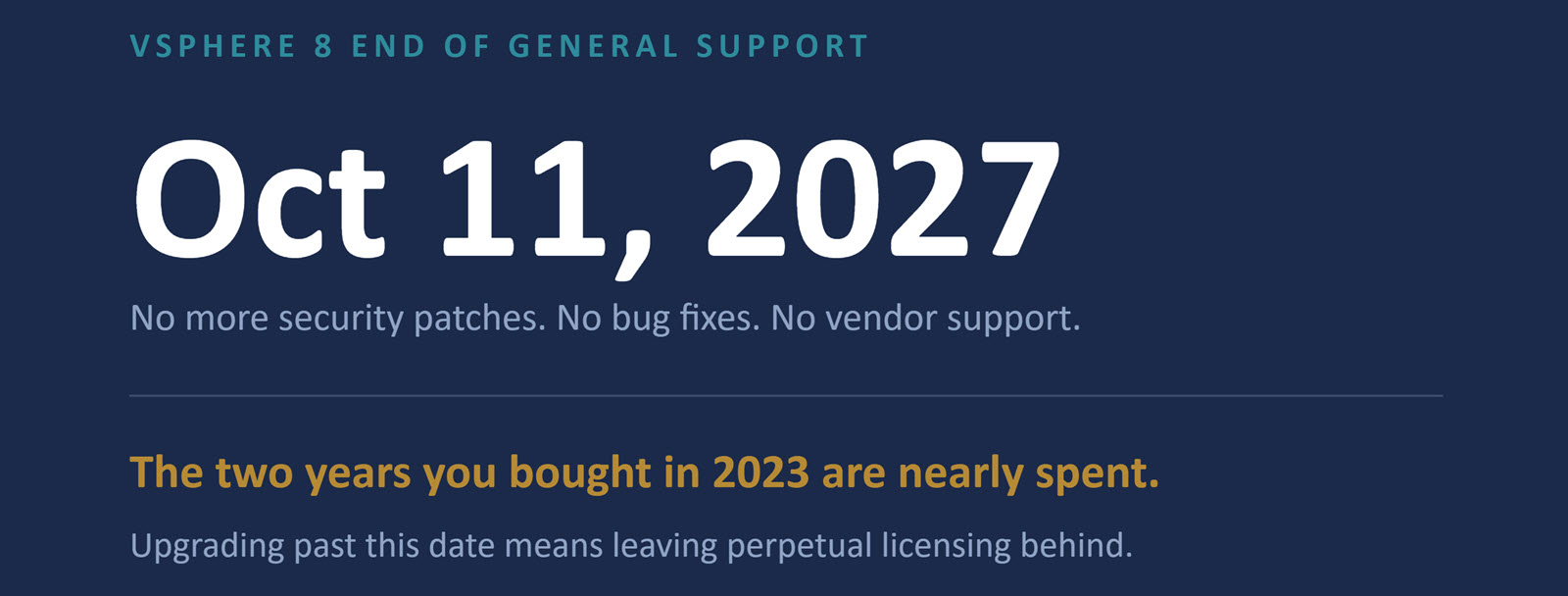
In 2027, the decision a great many organizations deferred comes due. The version of VMware they upgraded to specifically to buy time reaches the end of its supported life, and the runway they purchased runs out.
A Clock That Was Set in 2023
When Broadcom acquired VMware in late 2023, the uncertainty that followed sent a wave of organizations from vSphere 7 to vSphere 8. The move was sensible. vSphere 8 was current, supported, and familiar, and upgrading bought roughly two years to work out a longer term strategy without immediate pressure. It was a stabilizing decision made by careful people.
That two years is nearly spent. vSphere 8 reaches end of general support on October 11, 2027. After that date there are no more security patches, no bug fixes, and no standard vendor support. A separate technical guidance phase runs to 2029, but it is advisory only, which means someone will answer the phone and no one will fix the problem. For anything carrying real workloads, October 2027 is the wall, not 2029.
The organizations most exposed are not the ones who ignored the Broadcom transition. They are the ones who responded to it early, chose the stable path, and reasonably assumed the matter was handled. The deadline they bought is the one now arriving.
Why This Is Not the Deadline It Looks Like
On the surface, an end of support date reads like a routine upgrade prompt. Move to the next version and carry on. Under Broadcom that instinct is where the difficulty begins, because vSphere 8 was the last version that could be perpetually licensed. Moving forward means moving to a subscription, and the destination is not a point upgrade. It is VMware Cloud Foundation, a bundled platform that carries networking and storage virtualization the previous generation did not, priced on a materially higher structure.
The technical reality compounds the commercial one. For organizations that adopted VMware because it made infrastructure simpler, the move to the current Cloud Foundation release can feel like a step in the opposite direction. The upgrade introduces a stack of new management components beyond the familiar vCenter, and the migration is better understood as a re architecture than as a version bump.
The Hardware Trap
There is a specific risk inside this transition that tends to surface late, when it is most expensive to discover. Older server processors that run vSphere 8 without complaint are treated differently by the current Cloud Foundation release. On vSphere 8, an aging CPU generates a warning. On the newer platform, the installer can refuse to proceed entirely.
Broadcom did preserve a great deal of compatibility, and thousands of server models carry forward, so this is not a blanket claim that existing hardware is finished. The problem is narrower and harder to see. Certain older processor families have fallen off the supported list, and some now require a formal exception request simply to run. The result is that an organization cannot know which side of the line its estate sits on without checking each system against a compatibility list that is still being revised. The phrase stay on VMware can quietly become buy new servers, and that discovery is exactly the kind that arrives halfway through a migration rather than at the start.
Three Doors, and Where They Lead
Faced with the deadline, most organizations find themselves choosing among three responses, and it is worth being honest about where each one leads.
- Upgrade to the current platform. Move to the new Cloud Foundation release, absorb the subscription pricing, adopt the new management stack, and refresh whatever hardware the compatibility list rejects. This keeps the estate on VMware, at a higher cost and a heavier operational model than the one that made VMware attractive.
- Extend or sidestep. Take third party support to keep running past the deadline, or move the same workloads to another hypervisor. This buys time and defers cost, but the applications are unchanged and the same platform decision returns at the next major version.
- Modernize the applications. Use the deadline as the occasion to move the workloads off their dependency on the underlying virtualization entirely, so that the platform question stops recurring.
The first two doors are what most of the market is selling, because most of the vendors in this conversation have a platform, a support contract, or a destination to move workloads into. Each of those answers solves the 2027 problem and leaves the underlying one intact. The applications that make a VMware exit hard are the same applications that will make the next transition hard, and the one after that.
The Question Underneath the Deadline
What makes a VMware environment difficult to leave is rarely the hypervisor itself. It is the portfolio of applications running on top of it, many built years ago on assumptions about fixed servers, local storage, and a trusted network perimeter. Those assumptions are what tie the estate to the platform, and no amount of moving virtual machines between providers or hypervisors changes them.
This is why the vSphere 8 deadline is worth treating as more than a licensing event. It is the loudest signal the industry has yet produced that infrastructure level workarounds have a shelf life. The organizations that come through it in the strongest position are the ones that stop asking where to run the workloads and start asking whether the workloads still need to run the way they do.
How Aspen Approaches This
Aspen works at the portfolio level, systematically assessing, refactoring, and re architecting legacy applications so they arrive in the new environment as cloud native workloads rather than transplanted virtual machines. Our Warp Drive Engine™ compresses the modernization effort, bringing the work on an individual application into a three-to-four-month window rather than the year or more conventional redevelopment tends to require. Because applications move in short cycles, they can be worked in parallel waves, and a portfolio that looked like a multi year program against the 2027 deadline becomes a manageable one.
The move off VMware still has to happen. Done this way, it happens once, and it produces an estate that no longer carries the dependency that created the deadline in the first place.
Let’s Talk
If your organization upgraded to vSphere 8 to buy time, that time is now measured in a handful of budget cycles, and the strongest position is the one taken early. If you would like to explore how a rapid, portfolio level modernization approach could turn the 2027 deadline into a cloud native foundation rather than another licensing renewal, we would welcome the conversation.
Book a call with Aspen: calendly.com/aspen-ess/aspen-ess-discovery-chat
