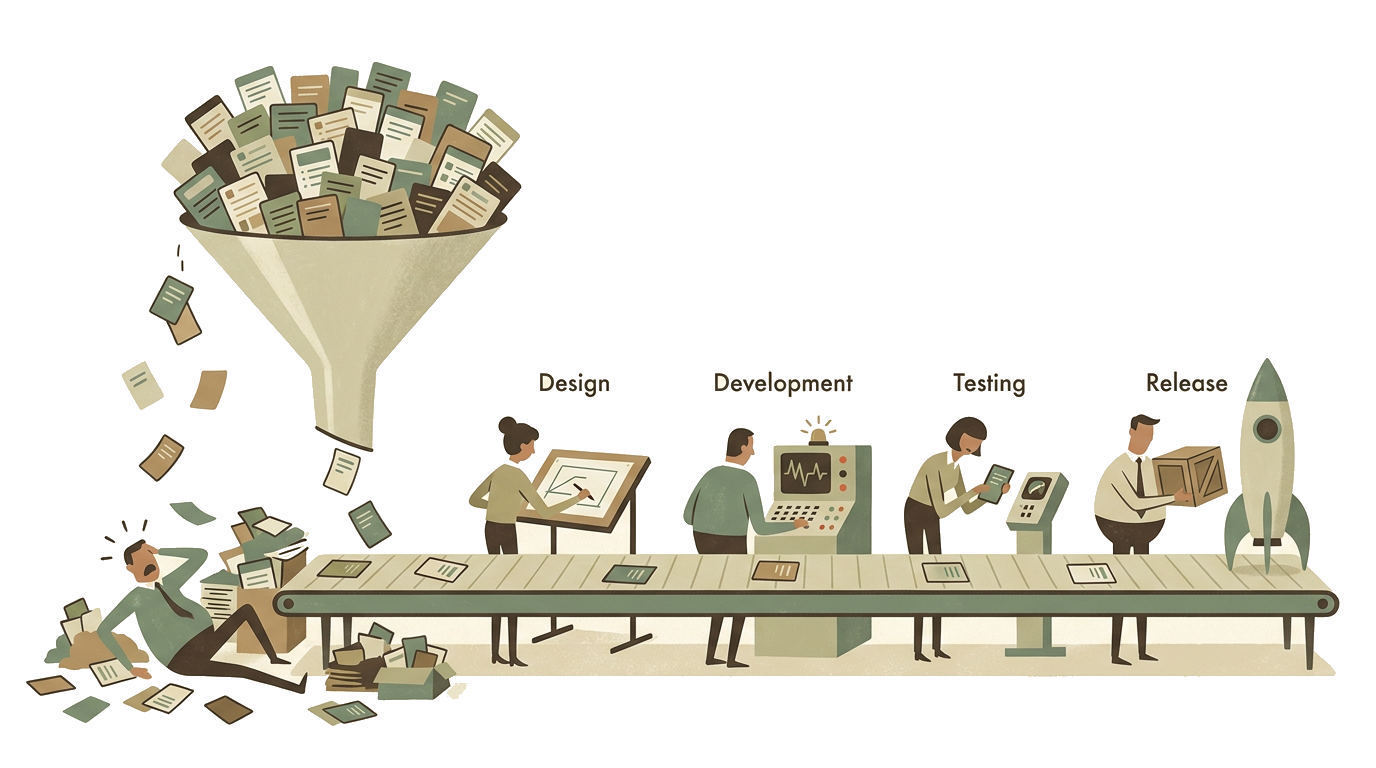
Most organizations eventually find themselves staring at the same uncomfortable reality. The development backlog keeps growing, yet the amount of work actually delivered never seems to catch up. New requests arrive faster than old ones are completed, priorities shift quarterly (sometimes monthly), and teams spend an increasing portion of their time navigating complexity rather than delivering value.
At first glance, the problem appears to be capacity. Leadership assumes the teams simply need more developers, more budget, or more time. Yet if you step back and examine the situation carefully, the pattern tells a different story. The backlog is not just a workload problem. It is a systemic one. Organizations that successfully break free from the never-ending backlog rarely do so by working harder. They change the conditions that created the backlog in the first place. That requires addressing the issue across several dimensions simultaneously, including process, governance, architecture, and culture. When these elements begin to align, the backlog starts to shrink naturally.
Stop Treating the Backlog as Normal
Many teams quietly accept large backlogs as a standard operating condition. In fact, some organizations treat them almost as a badge of honor, evidence that the business is generating “lots of demand.” In reality, a massive backlog is often a signal of systemic inefficiency. The first step toward regaining control is to conduct a candid audit of the backlog itself. How much of the work actually delivers measurable business value? How much exists simply to maintain aging systems, patch integration issues, or work around architectural limitations?
In short, you want to separate meaningful capability delivery from “keeping the lights on.” Once that distinction becomes visible, the scale of the structural problem becomes much clearer.
Prioritize Outcomes, Not Outputs
Backlogs tend to grow because organizations track requests rather than outcomes. Every feature request enters the queue, each stakeholder expects progress, and eventually the backlog becomes a long list of partially justified ideas competing for limited capacity. A better approach is to reframe prioritization around outcomes. Which initiatives actually move the business forward? Which capabilities drive revenue, reduce risk, or improve operational efficiency? Frameworks such as Weighted Shortest Job First (WSJF) or Impact versus Effort can help bring discipline to this process. They force stakeholders to quantify value relative to cost and urgency. And occasionally, they force difficult conversations. Saying no to low impact work is uncomfortable, but it is also necessary.
Refactor the Architecture
Even with improved prioritization, many development backlogs persist because the underlying systems make progress painfully slow. Monolithic architectures, tightly coupled integrations, and decades of accumulated technical debt turn simple changes into multi month projects. In those environments, the backlog is not simply a list of work. It is a reflection of architectural friction. Refactoring the architecture becomes essential. Systems must be modularized, components decoupled, and APIs standardized through modern interfaces such as REST or GraphQL. When teams can operate independently within clearly defined boundaries, delivery accelerates significantly. Every backlog item that takes weeks because of technical constraints should be viewed as a modernization signal. The architecture itself is asking for attention.
Implement Lean and Agile Governance
Traditional governance models often make backlog problems worse. Work enters through a ticketing system, approvals stack up across multiple committees, and by the time development begins the original business context has already shifted. Lean and Agile governance approaches address this by creating smaller, faster delivery loops. Teams operate in short sprints, demonstrate progress frequently, and maintain direct engagement with business stakeholders. Guardrails remain important, however. Only initiatives meeting defined ROI, regulatory, or operational thresholds should enter the development pipeline. Once approved, teams should have the autonomy to deliver without excessive procedural friction.
Invest in Continuous Automation
Development velocity improves dramatically when automation removes friction from the delivery process. Continuous integration and continuous deployment pipelines reduce release complexity. Automated testing improves reliability. Infrastructure as code standardizes environments and eliminates configuration drift. But automation does not stop at the delivery pipeline. It increasingly includes continuous modernization practices as well. Refactoring routines, dependency updates, and system optimizations can be incorporated into automated workflows, ensuring that modernization happens continuously rather than through occasional large projects.
Curb Scope Creep Religiously
Scope expansion is another quiet contributor to backlog growth. A project begins with a well-defined goal, then gradually absorbs adjacent requests, additional integrations, and new reporting requirements. Each addition seems reasonable in isolation, but collectively, they derail timelines. Effective organizations enforce scope discipline at the portfolio level. Technical debt remediation, feature development, and platform enhancements are tracked separately so that debt does not quietly accumulate. The discipline is not about saying no indefinitely. It is about sequencing work deliberately so that delivery remains predictable.
Kill or Archive Stale Backlog Items
One of the most revealing exercises an organization can perform is a backlog aging review. Items that have remained untouched for six to twelve months deserve scrutiny. If the request was truly critical, it would have been addressed already. More often, these items reflect outdated assumptions or ideas that lost relevance. Archiving them can feel politically uncomfortable. Yet leaving them in place creates a false sense of obligation and obscures real priorities. Over time, the backlog becomes less of a roadmap and more of a swamp.
Shift the Culture Toward Value Delivery
Ultimately, backlog reduction depends on cultural alignment. Teams must be rewarded for delivering measurable impact rather than simply increasing development velocity. Leadership plays a critical role here. Executives must be willing to defend the decision to eliminate low value work, even when individual stakeholders advocate for their own initiatives. The organization must collectively shift from “do everything eventually” to “deliver the most important things quickly.” That cultural shift changes how work enters the pipeline and how success is measured.
The Bottom Line
Organizations do not eliminate development backlogs by pushing teams harder. They redesign what they work on, how they work, and the systems supporting that work. It is helpful to think of the backlog as a garden. It requires pruning. Only the initiatives capable of producing meaningful outcomes should remain. New ideas should be planted selectively, and the environment itself should be engineered so that growth occurs naturally. Automation, modernization, and disciplined governance make that possible.
Accelerating with the Warp Drive Engine™
For many organizations, the most stubborn barrier to backlog reduction is the speed of modernization itself. Refactoring legacy systems, exposing modern APIs, and rebuilding components traditionally require years of effort. That challenge is precisely why technologies such as the Warp Drive Engine™ were created. The platform accelerates application modernization by automatically transforming legacy codebases, generating modern service layers, and producing CI/CD deployment packages that align with contemporary development practices. In practical terms, this means teams can refactor, re platform, and re architect systems far faster than traditional approaches allow. As modernization accelerates, development friction declines, and the backlog begins to contract. If this challenge sounds familiar, it may be worth having a conversation. You can book a call with Aspen to explore how the Warp Drive Engine™ may help your organization finally bring the development backlog under control.
