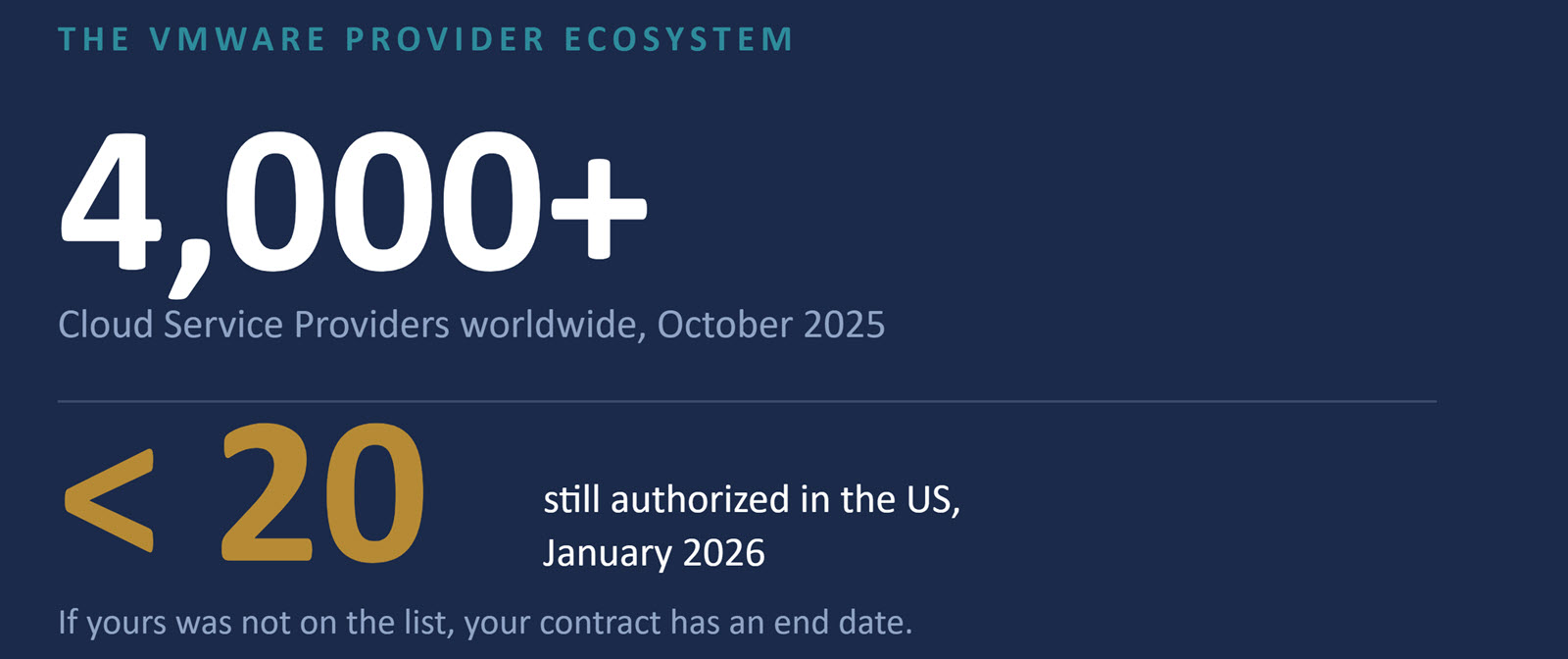
Broadcom has narrowed the VMware partner ecosystem to a fraction of its former size. For organizations running on a hosted VMware environment, the question is no longer whether to move but what to move toward.
A Deadline That Arrived Quietly
Most infrastructure deadlines announce themselves. This one did not. In January 2026, Broadcom issued formal non-renewal notices to VMware Cloud Service Provider partners across the United States and Europe, closing a program that once included thousands of providers worldwide. Existing customer contracts were allowed to run their course, which is why the practical horizon for most affected organizations falls in early 2027. Nothing broke that day. Nothing will break tomorrow. That is precisely what makes it easy to defer.
The providers affected were not marginal players. They were regional hosts, managed service providers, and specialist partners that organizations chose deliberately, often for data residency requirements, compliance considerations, or the simple fact that someone answered the phone. A much smaller group of authorized partners remains. In the United States, the retained list is measured in the low double digits.
What This Means for the Organizations in the Middle
If your VMware environment runs on a provider that was not retained, the position is straightforward even if the implications are not. That provider can continue to service your existing commitment contract. They cannot renew it, extend it, or add licensing capacity beyond its term. The relationship now has an expiration date, and it is written into a contract most organizations have not read in some time.
Several consequences follow, and they tend to arrive in a predictable order.
- Support quality erodes before the contract does. A provider winding down a business line does not staff it the way they did when it was growing. Response times stretch, senior engineers move to other accounts, and service levels quietly become aspirational.
- Negotiating leverage weakens as the deadline approaches. The number of authorized providers is fixed and their capacity is not unlimited. Organizations transacting this year have options that organizations transacting in late 2027 will not.
- The technical deadline lands in the same year. vSphere 8 reaches end of general support in October 2027, and VMware Cloud Foundation 9 introduces hardware compatibility requirements that many processors in service today do not meet. A number of organizations will face a provider decision and a hardware refresh in the same budget cycle. More on this in next week’s post.
- The cost structure has already changed. Perpetual licensing is gone, subscription terms carry multi year minimums, and modular products have been consolidated into bundles. Renewal increases of two to ten times prior spend are widely reported. Fewer providers competing for the work does not push that number down.
The Instinct to Move Sideways
Faced with this, the most common response is to find another place to run the same virtual machines. Move to a retained provider. Move to a hyperscaler. Keep the workloads intact and change the address.
That instinct is understandable, and in some situations, it is the right short-term call. It is also the option most likely to disappoint. Gartner’s research on cloud migration finds that lift and shift efforts frequently fail to deliver the expected benefits and often increase total cost of ownership rather than reduce it, because rehosted workloads do not scale elastically and cannot use the managed services that made the destination attractive. The workload arrives in a modern environment carrying every assumption it made in the old one.
A second cost appears later. A re hosted legacy application is still a legacy application. It still resists change, still depends on institutional knowledge held by a shrinking group of people, and still cannot take advantage of the elasticity, managed services, and automation that made the destination attractive in the first place. The organization has absorbed a migration cost and received an infrastructure change rather than a capability change.
Where the Question Actually Sits
The VMware situation is presented as an infrastructure decision, and at the licensing level that is exactly what it is. Underneath, it is an application question. What makes moving difficult is rarely the hypervisor. It is the portfolio of applications sitting on top of it, many of them built years ago on frameworks that assume a static server, a persistent local disk, and a network perimeter that can be trusted.
That reframing is useful, because it turns an externally imposed deadline into a decision most organizations were going to face regardless. The applications constraining a VMware exit are the same applications constraining cloud adoption, AI readiness, and the ability to respond quickly to whatever comes next. Solving for the deadline alone solves the problem once. Solving for the applications solves it permanently.
How Aspen Approaches This
Aspen works at the portfolio level rather than the individual application level, which is the only practical way to address an estate of dozens or hundreds of systems inside a compressed timeline. Legacy applications are systematically assessed, refactored, and re architected so they arrive in the new environment as cloud native workloads rather than transplanted virtual machines. The outcome is an estate that runs on modern deployment pipelines, uses managed services where they make sense, scales with actual demand, and no longer carries the architectural assumptions that made the original migration hard.
Organizations that take this path use the deadline as the forcing function it already is. The move off VMware happens because it has to. The modernization happens because that work was going to be required eventually, and doing it once costs considerably less than doing it twice.
The Road Ahead
Comprehensive VMware migration programs are commonly measured in eighteen months or more, and large portfolio efforts run considerably longer. Measured against a 2027 horizon, the planning window is narrower than the calendar suggests.
The usual conclusion is that there is time to move but no time to modernize. That conclusion rests entirely on how long modernizing a single application is assumed to take. Traditional redevelopment of one legacy application is commonly an eighteen-month undertaking, much of it consumed by discovery and analysis before meaningful work begins. Aspen’s Warp Drive Engine™ compresses that cycle to three to four months per application, which matters less as a single number than as a change in throughput. Applications that move in three to four months can be run in parallel waves across a portfolio, and the portfolio timeline contracts accordingly.
The organizations in the strongest position right now are the ones asking three questions.
- Was our provider retained and is it confirmed in writing.
- What does our contract actually say about its end date.
- Which of our applications would have to change before a modern environment would accept them on favorable terms.
The answers determine whether the next eighteen months are a managed transition or an emergency.
Let’s Talk
If this challenge sounds familiar, it may be worth a conversation. Many organizations are working through the same timeline right now, particularly those with large portfolios of legacy applications running on hosted VMware environments. If you would like to explore how a structured, rapid modernization approach could turn a VMware deadline into a cloud native foundation, we would welcome the conversation. Book a call with Aspen: calendly.com/aspen-ess/aspen-ess-discovery-chat
