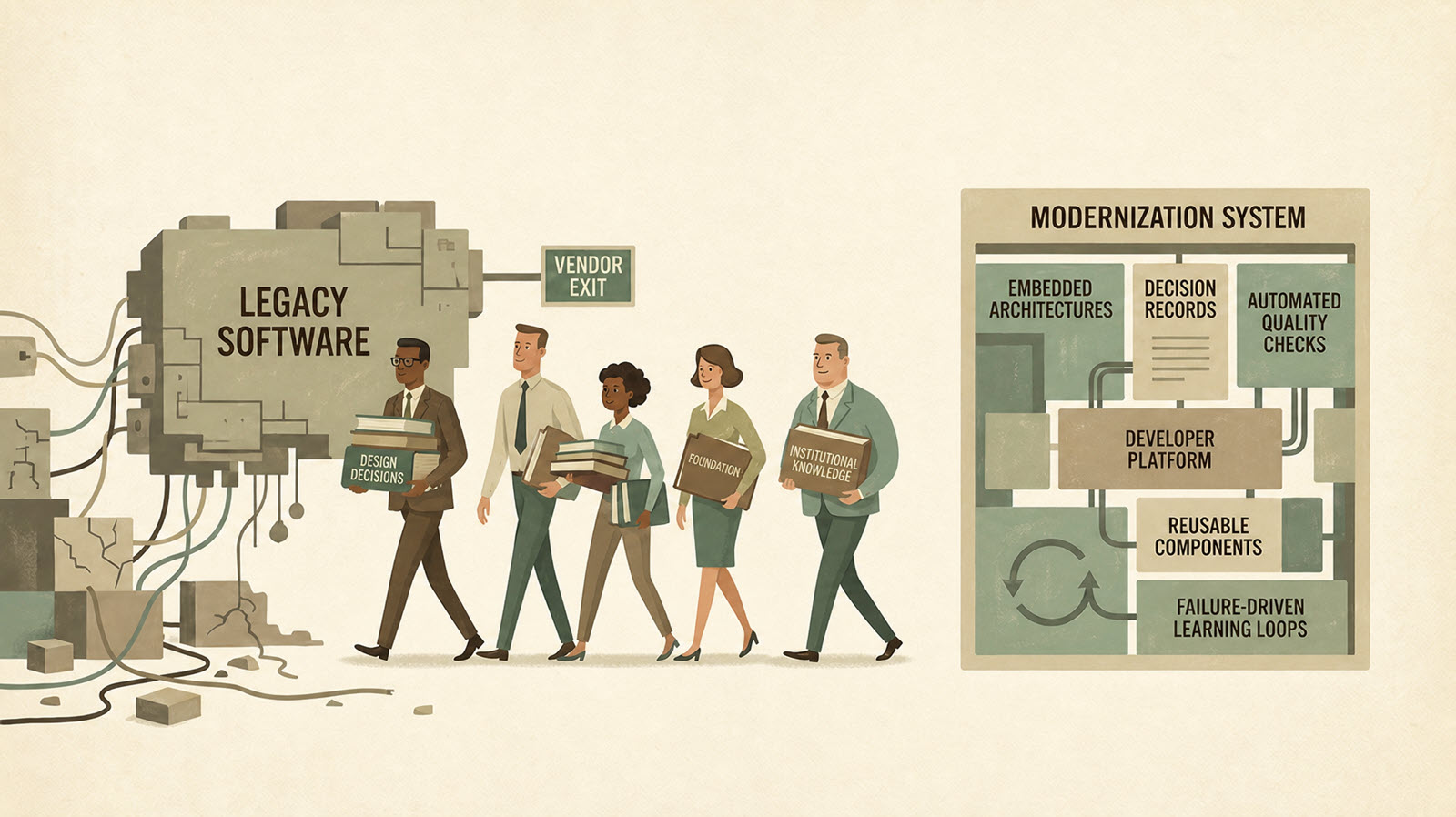
Somewhere in your organization is an application that only two or three people fully understand. It has been patched, extended, and quietly kept running for a decade or more, and the engineers who designed it left years ago. Modernizing that system does not just mean rewriting code. It means reconstructing judgment that was never written down in the first place.
The Consulting Firm Is Not the Fix It Looks Like
The natural response is to bring in a large consulting firm, one with a recognizable name, a bench of certified architects, and a case study for every industry. It feels like the safe choice. But the model has structural problems that rarely show up in the pitch.
The senior architects who scope and sell the engagement are rarely the people doing the day-to-day delivery work. That work typically falls to a rotating bench of consultants who ramp up on your systems, bill their hours, and roll off to the next account once the statement of work closes. The expertise you paid for shows up in the proposal. It does not always show up in the code. The incentive structure compounds the problem. Most large engagements are billed by the hour or priced as a fixed-bid with change orders built in, and a business that earns more the longer a project runs has little reason to compress the timeline. Whatever institutional knowledge the engagement produces mostly leaves when the consultants do, along with the documentation and the reasoning behind key decisions.
A Better Alternative
Instead of renting expertise by the hour, the goal is to build a modernization system where architectural decisions, security practices, and operational discipline happen by default, embedded in your own environment rather than in a consultant’s head. When that system is designed well, your own developers can consistently turn aging, brittle applications into modern, high-quality systems, without a multi-year engagement or a rotating cast of consultants learning your codebase on your dime. Looking across organizations that have modernized legacy portfolios successfully and repeatably, six practices appear again and again, and each one is something a traditional consulting engagement is structurally unlikely to leave behind.
Define Target-State Reference Architecture Standards
The first step is to reduce architectural ambiguity before a single line of legacy code is touched. Many modernization efforts, including consulting-led ones, begin with each team improvising its own approach to the target state, which invites inconsistency, duplicated effort, and unnecessary risk.
A better approach is to define reference architecture standards that establish a consistent target for every modernized application, typically a standard microservice template, a standard data access layer, an API gateway pattern for REST or GraphQL APIs, and a standard observability stack for logging, metrics, and tracing. A consulting firm building these standards usually keeps them as its own intellectual property, reused across its client base but never fully handed to yours. When the standards live in your environment instead, your team is not rediscovering the same patterns on the next project.
Capture Legacy Rationale with Architecture Decision Records
Legacy systems carry decades of undocumented reasoning. Business rules get buried in code, workarounds become permanent, and the people who understood why a decision was made have often moved on.
Architecture Decision Records (ADRs) address this on both ends of the process. During discovery, they document what the legacy system actually does and why, before anything is rewritten. During modernization, they document each new decision, the alternatives considered, and the reasoning behind the final choice. In a staff-augmented engagement, this documentation is often the first casualty of a compressed timeline, and the reasoning leaves with the consultants who made the call. Kept inside your own systems instead, ADRs stay long after any engagement ends.
Automate Code Quality and Security Reviews
Experienced engineers often serve as the last line of defense for code quality and security, and legacy applications tend to carry years of accumulated technical debt and unpatched vulnerabilities that make manual review even less practical. Modern CI/CD pipelines can enforce standards automatically instead, including static and dynamic code analysis, dependency vulnerability scanning, and minimum test coverage thresholds for every modernized component.
These checks turn best practices from suggestions into requirements. A modernized service that fails a security scan or violates established quality rules does not move forward in the pipeline. Manual review, the default in most consulting engagements, is exactly the kind of billable work a time-and-materials contract has little incentive to automate away.
Standardize an Internal Developer Platform for Modernization
Organizations tackling large modernization portfolios increasingly invest in internal developer platforms built specifically for that work, giving teams a standardized environment that includes service templates, automated deployment pipelines, built-in security controls, observability, and policy enforcement.
For developers, the platform removes the need to assemble migration tooling from scratch for every application. A consulting firm building this for a single client rarely invests beyond what one contract will fund, and once the engagement ends, your team is often left maintaining infrastructure the firm no longer supports.
Embed Expertise in Reusable Modernization Components
Senior architects should not spend their time reverse engineering every legacy codebase personally. Their expertise is far more valuable embedded into reusable components every modernization team can draw on, including security libraries, authentication modules, data access frameworks, and observability utilities maintained centrally.
When these components are built into the modernization process by default, teams inherit expert design decisions without needing to reproduce them for every legacy application. In a traditional engagement, these components tend to get rebuilt bespoke for every client, since a firm’s revenue depends on billable hours, not on components that make the next project faster.
Build Failure-Driven Learning Loops
Legacy modernization rarely goes perfectly on the first attempt, and it does not need to. What matters is whether each migration issue, performance regression, or production incident becomes an isolated lesson or a permanent improvement to the modernization system.
High-performing organizations build failure-driven learning loops into their modernization programs. Post-incident reviews capture what happened and why, and the resulting safeguards get folded into reference architectures, migration templates, or automated pipeline checks. In a consulting engagement, those hard-won lessons usually travel with the consultants to their next account, not with the organization that paid to learn them.
A System Outlasts an Engagement
Taken together, these practices reflect a different way to think about legacy modernization. The objective is not to rent a team of experienced consultants for the length of a contract. The objective is to build a modernization system that stays inside your organization long after any engagement would have ended, producing high-quality, secure, and maintainable software on your own terms. A well-designed system outlasts any statement of work.
How Aspen Compares to a Traditional Modernization Engagement
Building all of this internally, reference architectures, a developer platform, reusable components, and automated security controls, typically takes months or years of effort, which is exactly the gap large consulting firms have historically filled, at a cost. Aspen’s Warp Drive Engine™, comprising Aspen Foundation™, Aspen Transform™, and Aspen Synthesis™, embeds each of these practices directly into your modernization process, compressing the work on an individual application into a three-to-four-month window rather than the twelve to eighteen months a conventional SI-led engagement tends to require.
The difference is not just speed. What the platform builds stays in your environment, owned by your team, rather than walking out the door with a consultant once the contract ends.
Let’s Talk
If your organization is weighing a multi-year engagement with a large consulting firm, it may be worth a shorter conversation first. We would welcome the chance to discuss how a modernization system, owned by your team rather than rented from a vendor, could get you to the same outcome faster and leave you with more than a modernized application when it is done.
Book a call with Aspen: calendly.com/aspen-ess/aspen-ess-discovery-chat
